New findings from MARC SE-Africa support WHO efforts to enhance surveillance and combat antimalarial drug resistance in Africa
A new MARC SE Africa-led study, in close collaboration with the WorldWide Antimalarial Resistance Network (WWARN) and a large international study group, has produced the most geographically comprehensive individual-patient data meta-analysis to date, examining the role of malaria parasite mutations in driving the evolution of less effective treatments. Specifically, this work illustrated the association between mutations in the Kelch13 gene region of Plasmodium falciparum and delayed response to artemisinin-based malaria treatment.
The study, “Association between Plasmodium falciparum Kelch13 mutations and malaria parasite clearance half-life after artemisinin-based therapy: an updated WWARN systematic review and individual patient data meta-analysis", investigated data from 16,823 patients across 45 studies, 539 study sites and 33 countries, including 22 countries in Africa.
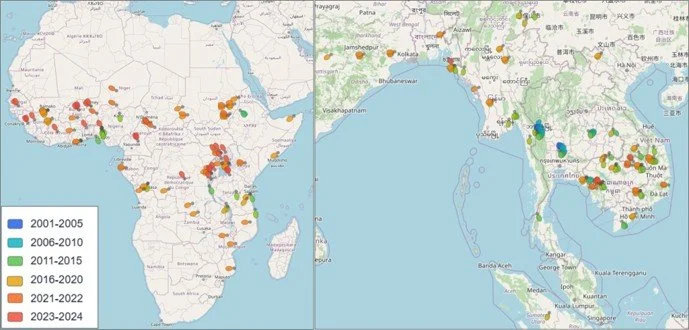
Geographical distribution of the 539 study sites included in the analysis across Africa and Asia, coloured by study period.
Collective effort enabled new insights into antimalarial drug resistance
The analysis reflects the contributions of more than 120 researchers and investigators who were actively involved in generating this critically timed information. This scale of collaboration is important as antimalarial resistance does not emerge uniformly globally. However, this collective data enabled stronger insights into how parasite mutations affect treatment outcomes across malaria-endemic settings and regions. Data from many malaria-endemic countries and transmission settings make it possible to identify patterns that would be difficult to detect in a single study or location. The study group included investigators involved in study design, implementation, data generation, scientific oversight, harmonisation and analysis.
Findings shed light on the current state of resistance in Africa
The findings are particularly important for Africa, where artemisinin partial resistance is now emerging independently in several parasite populations. The analysis confirmed strong associations between WHO-recognised Kelch13 mutations and slower parasite clearance after treatment, and identified additional emerging mutations in African parasite populations that warrant further surveillance.
“Artemisinin partial resistance is an increasing concern for malaria control in Africa. By bringing together data from thousands of patients across diverse transmission settings, we were able to better understand how resistance is emerging across the continent and, importantly, how we can improve its detection. Seeing these findings contribute directly to discussions with the World Health Organisation is an important step towards translating this collaborative research into stronger surveillance and public health action.” Dr Stephanie van Wyk, University of Cape Town, lead author.
The study also showed that resistance can be more difficult to detect in moderate- and high-transmission settings, which are common across Africa. The findings suggest that some of the thresholds currently used to identify delayed parasite clearance may need to be interpreted in light of the malaria transmission setting.
From new data to policy change
On 2 September 2026, Dr Stephanie van Wyk and Dr Prabin Dahal presented the findings to the World Health Organisation Working Group on artemisinin partial resistance thresholds. The discussion focused on how these data could inform the review of methods and thresholds used in the WHO Compendium of molecular markers for antimalarial drug resistance and improve downstream surveillance efforts.
The work demonstrates the value of large-scale collaboration in bringing together data generated across Africa and beyond, and how these data can move from research into discussions that directly inform malaria surveillance and policy.
The manuscript is currently under review and is available as a preprint.