New preprint: When treatment resistance mutations spread, does the malaria burden increase?
Mutations in the Kelch13 gene of the malaria parasite Plasmodium falciparum have been well studied for their role in conferring partial resistance to artemisinin, the fast-acting component of artemisinin-based combination therapies (ACTs). These mutations allow parasites to survive longer following treatment, potentially increasing the risk of treatment failure.
But could these mutations have consequences beyond individual patients? Could the spread of resistant malaria parasites contribute to more malaria cases and potentially a greater burden of severe disease and death?
The World Health Organization (WHO) identifies a prevalence of 10% or more of validated Kelch13 resistance markers as an important warning threshold. Yet what does the expansion of these mutations mean for malaria transmission and disease burden at the population level?
Researchers from MARC SE-Africa investigated this question in their new preprint, “Expanding Kelch13 artemisinin resistance markers are associated with higher malaria incidence in Uganda”.
Why Uganda?
Uganda carries one of the highest malaria burdens globally and has experienced a rapid expansion of artemisinin partial resistance-associated mutations in recent years. This makes it an important setting for understanding what happens as drug-resistant malaria parasites emerge, spread and become established.
Bringing together Ugandan malaria experts, molecular surveillance specialists and researchers in epidemiology and advanced statistical analysis, the team examined malaria trends across Uganda.
The researchers combined parasite genetic surveillance with routine health data on confirmed malaria cases, hospitalisations and malaria-associated deaths. They also considered environmental conditions, mosquito-control interventions, other antimalarial resistance markers and disruptions to malaria services during the COVID-19 pandemic.
This comprehensive approach allowed the team to investigate the relationship between drug resistance and malaria incidence while accounting for other important drivers of malaria transmission.
What did the researchers discover?
Resistance spread rapidly: In 2017, just one of 16 districts had Kelch13 mutation prevalence of at least 10%. By 2022, 11 districts had reached 20% or higher.
More resistance means more malaria cases: Every 10% increase in Kelch13 mutation prevalence was associated with 13.1% higher malaria incidence, even after accounting for other major drivers of malaria.
Other drug resistance markers also mattered: The pfcrt K76T mutation was also associated with higher malaria incidence.
Malaria prevention still makes a difference: Insecticide-treated nets and indoor residual spraying were associated with substantially lower malaria incidence, reinforcing the importance of sustained malaria-control efforts.
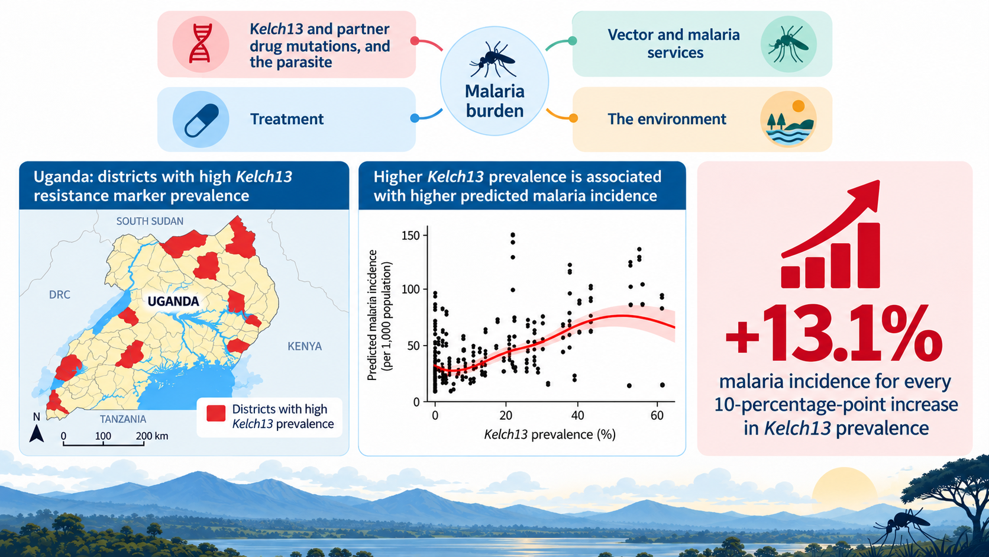
Exploring the relationship between antimalarial drug resistance and malaria burden in Uganda.
Together, these findings provide important new evidence that the spread of resistance-associated malaria parasites is linked to malaria burden at the population level. While the relationship is complex and may operate in both directions, the study takes an important step towards understanding the broader public health consequences of antimalarial drug resistance.
What does this mean for malaria control?
The findings raise important questions about how malaria programmes interpret and respond to emerging resistance.
While genetic surveillance can identify where resistant parasites are spreading, understanding how these changes relate to malaria incidence is essential for anticipating their wider public health consequences.
“Malaria experts have become increasingly effective at molecular surveillance, identifying where antimalarial resistance is emerging and spreading. The next challenge is understanding what this means for the affected communities. Our findings suggest that the consequences of resistance may extend beyond delayed treatment response, with potentially important implications for malaria transmission and burden at the population level. Bringing molecular, clinical and epidemiological evidence together will be essential for guiding future treatment policies and protecting the gains made in malaria control.” - Dr Stephanie van Wyk (University of Cape Town), lead author.
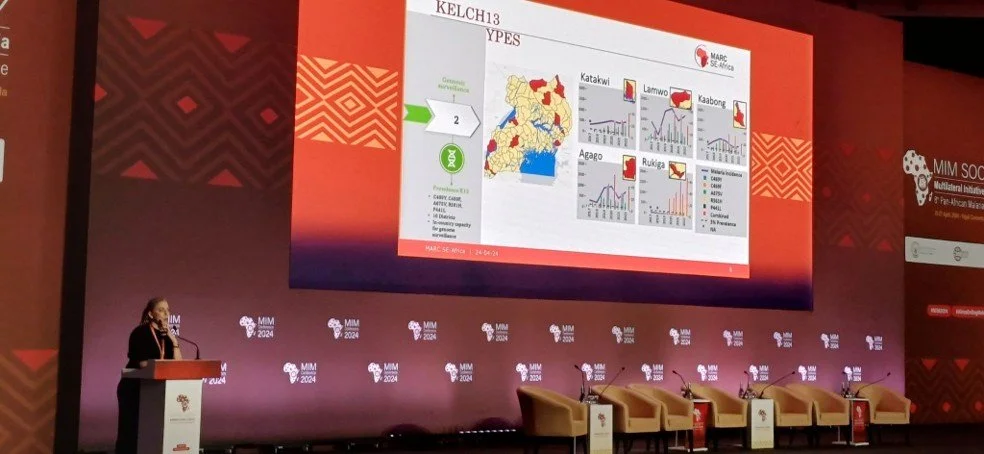
Dr Stephanie van Wyk presenting this work at the Multilateral Initiative on Malaria (MIM) Society Pan-African Malaria Conference in Kigali, Rwanda in 2024.
Looking ahead: From resistance surveillance to public health action
As artemisinin partial resistance continues to spread across Africa, malaria programmes face increasingly complex decisions about when and how to adapt treatment policies, diversify first-line therapies and introduce new antimalarial medicines.
This research demonstrates the value of combining local malaria expertise, international collaboration, molecular surveillance and advanced analytical approaches to understand the wider consequences of antimalarial drug resistance.
Through its regional and global partnerships, MARC SE-Africa is bringing together the expertise needed to translate resistance surveillance into evidence that can inform malaria-control policies.
Understanding not only where resistance is spreading but also what it means for the malaria burden will be essential for protecting existing treatments, guiding the deployment of new therapies, and shaping future malaria-control strategies across Africa.